To Wounded Arrow: Prologue

Prologue

As a Family Support Worker, I had transported my new 11-year-old client to Anger Manage-ment at Child Guidance. My caseworker informed me before I picked young Jessie up that he came from dysfunction junction. His father and his older brothers were bikers who had been asked to leave their small country town when the “boys” had demolished head-stones in the town’s cemetery. My caseworker also informed me that she had received death threats on her and her unborn baby from this same clan due to the fact Jessie had been removed from their home. Her last words to me were, “Watch yourself. Jessie may prove to be a handful.”

I sat there in the waiting room calmly reading a magazine, when suddenly, a colorful barrage of words exploded from inside the session room. A chair slammed against the wall. The door burst open. Jessie went racing through the waiting room filled with startled parents. He then ran down the hallway and dove into the opening door of an arriving elevator.

By the time I reached ground floor, Jessie was already two blocks ahead of me. He led me on what turned out to be a six-block chase down to the Rampark Parking Garage.

When I reached the 6th floor of the open-air garage, Jessie had climbed onto the ledge and was seated facing forward, dangerously close to falling sixth stories to the sidewalk below. He held himself by only the tips of his fingers, his arms extended behind him, his head aimed in the direction of his proposed flight down as he said, “Come any closer and I will jump!”

I stayed where I was.

Jessie focused on the Social Services building two blocks away and said, “Do you know what those assholes did to me? My entire family are bikers, and they placed me in the foster home of a damned cop! Who am I supposed to be loyal to? I just wanna die!”

I determined at that point that young Jessie was determined to take the hard way down from there.

“Just–listen to me,” I said, badly winded from my run to catch him.

Jessie scooted himself to the edge of the ledge. “I don’t wanna listen! I just want to jump!”

Jessie gripped the ledge with his fingertips and leaned forward, tears glistening on his cheeks. He angrily spat, “Some kids shoot themselves. Some kids take sleeping pills. Some cut their wrists. Some hang themselves. I used think to those kids were stupid! But, now I know why they do it.”

Inching my way to his perch on the ledge, I froze when he snapped, “They say I can’t go back to my real home for a long, long time. I just can’t take this, so just let me jump!”

Tempted to lunge and latch onto him, I said, “So, you’re going to let tunnel-vision push you over the edge, huh? You’re only focusing on one thing, not looking beyond your immediate problem. You think you’re at the lowest point in your life–”

“I am at the lowest point!” Jessie blurted. “Tell me, what do I have to live for?”

“Returning to your family one day,” I said, then nearly added, “because what doesn’t kill you, just makes you stronger.” But it wasn’t the time to quote sappy movie lines that sounded like verses of Scripture ever since Arnold quoted them in Conan.

No. Instead I simply said. “You said they are all bikers, right? But since you just want do die, guess you ain’t a biker then, right?”

“What?” Jessie snapped. “What do you know about me? What do you know about any of this?”

‘Oh, kid,’ I wanted to say, ‘because I grew up wanting to be a biker all of my younger days! I
dreamed of becoming a biker up until the day I got a reality check and got locked up in the detention home! Oh hell, yes, I knew all about bikers, kid, long before you were ever born!’

But I didn’t. Instead I said, “Well, one thing Bikers are that you’re not, and that is: Bikers are tough. If you were really that tough, you wouldn’t even think that suicide was an option. No, if you were really that tough, you wouldn’t let them win this one over on you.”

Because toughness meant something to Bikers. I knew that. So did he.

He followed my gaze to the Social Services building, then refocused on the street far below.

I continued. “Show them how tough you are. Climb down off that ledge, Jessie.”

Twenty long minutes passed as I tried to convince him that suicide was not an option. After one last look to the sidewalk below, he leaned back, allowing me to haul him off the ledge.

Relief washed over me. Something different settled on Jessie’s shoulders. Resolution. Deter-mination. Perseverance. Maybe a combination of all three.

Moments later, walking past the spot on the sidewalk where he would have landed had he jumped, Jessie muttered, “I guess I’m tougher than I thought.”

And my response to that was, “Maybe we all are.”

***

As I drove Jessie back home that day, I shared with him a story of my own childhood days, when I thought I was tough:

I was a scrawny, shaggy-haired 13-year-old kid wearing an American Flag on the back of my cut-off jean jacket, and staying the weekend with a friend down in Sprague, Nebraska, population 18.

My friend, tall, red-haired Richard Kempston, said, “Sprague is home to a bunch of rowdy, beer-chugging rednecks. Take that jacket off before we go inside the tavern, or you’ll come outta there with a hair cut and that flag shoved into your mouth!”

I smugly said, “Hey, any redneck who has a problem with my flag can kiss my ass!”

“More like kick your ass,” Richard muttered as he followed me into the tavern.

We were immediately engulfed in clouds of thick cigarette smoke while a dozen rednecks seated around the room, glared at us. We casually walked across the crowded room and waltzed up to the bar, Richard, shooting nervous glances at the unfriendly faces focused on us.

And that’s when this big, red-faced farmer, dressed in denim overalls and wearing a DeKalb hat, walked over and stuck his big, fat finger into the middle of my back, pinning me to the bar.

Redneck Farmer shouted, “Hey, everyone, do you see this kid’s flag? Huh, do you see this damned flag this kid is wearing? Well, do you know what I think of it?”

I glanced back over one shoulder and took in all the leering faces of the expectant crowd. They surely knew I had earned this big drunken man’s animosity. I glanced sideways to Richard, thinking, Maybe I should have listened to him, and not been so cocky about wearing my flag into the tavern.

Redneck Farmer poked me again, and this time he said, “Well, kid, do you wanna know what I think of this damned flag you’re wearing on this damned jacket?”

“Not really,” I meekly whispered. “But I’m sure you’re gonna tell me.”

The big man laughed and said, “Oh, yeah, I’m gonna tell you, all right.”

He then belched and patted me on the back and said, “I think it’s pretty goddamned patriotic! And bartender? I want to buy this kid a hamburger and fries!”

I about fainted in relief, but I managed to say, “And two large Cokes for me and my friend?”

A few minutes later, Richard sat drinking his free pop in wonder, while I ate my hamburger and fries, bought and paid for all because of Redneck farmer’s patriotic streak, and because of my gutsiness to wear that flag into that redneck bar.

***

Two months later, I had another encounter because of my flag on the back of my jean jacket. My friend, Craig Cline and I were riding a city bus. The bus driver, a lean, cocky, sandy-haired guy drove for a little ways, almost getting us to our destination, when he couldn’t take it anymore. He just had to stop his bus and come back down the aisle to confront me.

“You think you’re pretty damned smart,” Sandy said. “Pretty damned smart to be wearing that flag! Do you know how many of my buddies died in Nam defending your right to wear that damned flag? Huh, do you?”

“No,” I smugly said. “But I’m sure you’re gonna tell me, aren’t you?”

It was strangely reminiscent of my conversation with Redneck Farmer down in Sprague. But I could tell this was not going to have the same positive outcome. No, this was going to turn ugly as I stood there, glaring back at my own refection in his mirror shades.

Sandy latched onto my skinny shoulders, lifted me off my feet, and shoved me toward the exit door. “Get the hell off of my bus!” he demanded.

“Hey,” Craig said, “you can’t do that! We paid for our ride!”

Sandy glared at lanky, long-haired Craig and simply shoved him toward the door as well.

Craig and I took one last look at fuming Sandy and exited his bus.

The two of us proceeded to flip off the retreating bus as Sandy drove off down the street, leaving us choking on diesel fumes.

Unfortunately, we had attracted the attention of the five members of a biker gang known as the Screaming Eagles, who happened to be sitting there across the street on their front porch.

Mike Shade, a big, brawny bear of a biker with long, shaggy dark hair and a thick black beard, spotted my flag on my jean jacket. He ordered me to come up there to the porch.

I didn’t have much of a choice. Leaving Craig standing there in the street, I slowly walked up to those five bikers seated there on that porch. Funny, I often drive by the same place now days, and that porch sure seemed to be a lot farther away from the street back when I was a kid. Because it seemed like it took me forever to walk from the street to face those five bikers.

Shade came up off the porch and whipped out a large pocket knife. He latched onto me, spun me around, and displayed my flag for his four gang members. “I’d say these are colors, wouldn’t you? And I don’t think Moses would like it that this little punk was wearing colors like this, do you? I think I should be cutting this flag off your back, you little asshole. What do you think?”

He then put the tip of his knife on my back and was just starting to cut my flag off when I said, “If Moses has a problem with my flag why don’t he talk to Johnny Bradford about it?”

Shade froze, his knife poised to cut. “You know Johnny Bradford?” he asked, slightly shaken.

“Yes,” I replied. “And he finds out you so much as touched me, he’ll kick your ass!”

Shade was smarter than he looked. “Well, I was just giving you a warning. Mother Moses, is the President of the Screaming Eagles–”

I blurted, “I know who Moses is. But if Moses or you have a problem with me wearing my flag, then go talk to Johnny about it.”

Shade put his knife away. “Yeah,” he said, “Moses and I will talk to Johnny. This was just a warning, nothing else. Be sure to tell Johnny that when you tell him about this, okay?”

He released me then, and as I walked away from him, I said, “Oh, you can bet I will tell Johnny about this. So don’t be surprised if he comes and talks to you.”

“Look, kid,” Shade said, “you don’t have turn this into something ugly. I didn’t rough you up or nothing. All I was doing was giving you a warning, right?”

“Yeah,” I said as I returned to the street. “That’s all I was giving you, too. A warning, right?”

Craig fell in beside me as I smugly walked away, shooting defiant glances back at Shade and his gang. By the time we were a block down the street, I shared with Craig how I had gotten out of that particular situation.

Craig looked at me in disbelief. “Johnny Bradford? You don’t even know Johnny Bradford!”

I grinned at him and said, “I know, but Shade didn’t know that!”

***

Back in those days, I hung out with a group of bikers who lived there on Saint Paul Avenue, and they always talked about how they would never want to mess with Johnny Bradford because he was bad to the bone. I just happened to remember his name while I was standing there before Shade. Luckily, Johnny’s name carried enough weight to cause Shade to back off.

One month later, I ran away from home. My mom had the police looking for me and even had my name announced on all the radio stations. Little did I know, she had also enlisted the help of one of my older friends from the Saint Paul neighborhood to hunt me down. 18-year-old Dennis Grant was a legend and a biker in his own right, though he belonged to no gang. Grant had a bad reputation. Bikers from both sides of town respected him. And what’s more? Grant was my friend, and yet he’d taken my mom’s side that night when he showed up at Midwest Speedway on 27th Street, prepared to cart my sorry butt home.

Craig and I were just leaving the raceway, when we had a run-in with the Belmont boys. There were five of them, all hulking beasts who were at least five years older than us. They surrounded us and their leader started shoving me around, having taken offence at the flag I was wearing.

Into the middle of the swarm of the five Belmont boys, a brawny figures appeared. It was Dennis Grant. Grant and his friend, Bobby Barnett, had little trouble sending the Belmont goon squad packing. Once they did, Grant turned to me, casually lit a cigarette, and said, “You are coming with me. I’m taking you home to your mom. And don’t give me any lip!”

Instead, I gave Grant the slip.

I pointed past him and Bobby and said, “Hey, ain’t that Geno over there?”

I couldn’t believe it. They both fell for it, and so, I wheeled around and took off running.

Craig started laughing, which earned him a punch in the stomach from Grant, and then Grant and Bobby started chasing me through the race track crowd.

I slipped through the mob of people like a greased cat, spinning and dodging and putting distance between myself and Grant and Bobby, who were now pissed off at me for running from them.

Finally, I darted under the track bleachers and climbed in between two seats to make my way up into the crowd watching the races.

Grant tried to grab my legs as I scuttled away, which made him even madder. Between the bleacher seats, he looked up at me and snarled, “Your ass is grass, when I catch you, Tommy!”

I peered back down at him and said, “First you gotta catch me!”

Which was a stupid thing to say. It just made him more determined to catch me and thump me good for running from him in the first place.

I scrambled through the crowd and made my way down to the front of the west side bleachers, and was just running over to the east side when Grant and Bobby appeared between the middle of both crowded bleachers.

I thought I was dead, but luckily a mob of kids stepped right into their path, and I hightailed it up into the crowded east side bleachers.

Someone called my name, and I looked up to see a large group of guys in cut-off jean jackets seated at the center of the otherwise normal looking spectators. It was Big Tim and his gang known as the Devil’s Fly High. They weren’t as bad as the Screaming Eagles, but in a fight they could hold their own. And the best thing about it is, Big Tim was calling my name!

I immediately scrambled up and seated myself right down in the middle of the rowdy group of guys. And then Big Tim saw me staring wide-eyed at Grant and Bobby coming up the steps of the bleachers. “They after you?” he asked. “What did you do to piss them off?”

“Nothing,” I shot back, defensively. “Just ran away from home, and they’re trying to take me back. Don’t let them, Tim, okay?”

Big Tim could have leveled both Grant and Bobby without working up a sweat, but there was one factor he was thinking over very carefully: If he interfered with these guys, he would have Geno to deal with later. Geno was Grant and Bobby’s best friend, another biker with a fierce reputation. And in a fight between Geno and Tim, God only knew who would win.

“I think,” Big Tim said, frowning, “you had just better go with them, Tommy. I don’t got no dog in this fight, and I think I’ll keep it that way, understand?”

“No!” I nearly cried. “I don’t want to go with them! They’ll just make me go back home!”

Grant and Bobby were almost on me, having climbed the bleachers about fifteen feet away. I was surely going to not only get an escort back to my house, I was probably going to get thumped by Grant for ditching them like I did.

That’s when this medium-sized guy with broad shoulders and thick, muscular arms stood up beside Big Tim. The brown-haired guy in his late 20’s looked down at me and grinned. “These guys are after you, huh? Well, you just stay put. I’ll take care of them.”

The guy brushed past me and stood in the path of Grant and Bobby. He then reached out, latched onto the back of their necks, and slammed their heads together! I swear I actually heard a Crack!

Grant and Bobby swooned then, but the guy simply held them real close and whispered something in both of their ears. Both Grant and Bobby reacted simultaneously, raising their hands, palms to the sky and backing away from the guy.

He stood there, glaring at them until they retreated back down the stairs and disappeared around the corner of the bleachers.

The guy brushed past me once more to take his seat beside Big Tim. He then winked at me and said, “You stay here with us and they won’t give you no more trouble tonight, kid.”

Whew! I was saved by . . . And that’s when I leaned over to Louie Ross, the youngest member of the Devils, a kid about my age. I said, “Who the hell is that guy?”

Louie glanced over at the guy and said, “Oh, him? Hell, that’s Johnny Bradford!”

Something from Nothing: Part Two . . .

Two years before Scratchin’ on the Eight Ball took a nose dive, I had landed a job as a Nebraska Storyteller and a Guest Artist in the schools. After one of my speaking engagements, Bob Furman, Director of the YMCA’s Camp Kitaki, approached me, asking me to write a storyline for a challenge course that he’d planned to introduce at the camp near South Bend.

One week later, I met with Bob and handed him the script for Jungleland. The premise was that an airplane had gone down in the Amazon jungle, and 10 campers and their counselor were the only survivors. So in effect, each cabin full of campers who ventured down into the woods to Jungleland, were interactively involved and required to overcome each of the nine obstacles to win through the course.

Bob asked me what kind of payment I wanted for the finished work. So I asked him for camp scholarships for two of my neighbor boys. I had met the family down the street months earlier while trying to find a home for a Golden Retriever puppy I had found here in Havelock. The two boys, Trevor and Brandon, talked their mom into adopting it, and “Bear” got along great with my Dobie and my Keeshound, so she ended up at my house most days of the week. The dog did not come without the two brothers, however.

So when the week of camp ended, Brandon was so enthused, he asked me to get him another free contract for the next year. I told him I would see what I could do about that. Both boys, Brandon at 10 and Trevor at 13, were fascinated with the dozens of “padded” swords I had just received from my friend, who designed and patented the foam-padded, cloth-covered swords, naming them S.W.W.S. (Softwar Weapons System). Gary Cline was a childhood friend, and he and I had grown up whacking the hell out of each other with broom stick-swords. Gary decided to improve on our weapons, and he designed the thickly padded swords that one could wield without cracking knuckles or breaking bones.

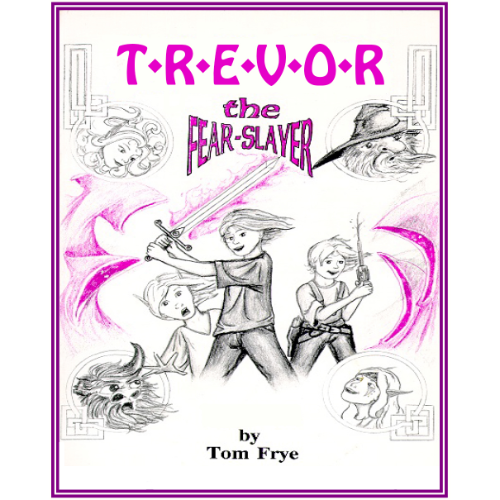
It was Trevor who threw the pebble in the pond, causing the ripples to spread, when he said, “We should create a program where kids have to use padded swords to capture a flag or go on a quest. I bet every kid in Lincoln would sign up for it!”

Later that evening, I wrote a new challenge course, one that I named, Castlelan, based on the chief kingdom in my Fantasy book, The Jewel Folk. In a forty-five minute span, I typed madly away at the keyboard of my old Commodore computer and created an interactive play. The story was that a young prince of the Kingdom of Castlelan came seeking a Bard, asking his aid to help free the King and his Knights from the curse of the Seven Dragons of Dread.

In the opening scene, Prince Corin duels with Anarian the Bard, and as they fight, the Bard tells young Corin about the Dragons, named for their particular evils, Fear, Hatred, Lies, Selfishness, Darkness, Foul-Mouth, and False Dreams. The Dragon of False Dreams, the Bard explains created the potion trade (drugs) that plagues the kingdom. In order to defeat these Seven Dragons, the Bard claims that Prince Corin must agree to venture to the Grove of the Seven Trials, and therefore be granted the Seven Words of Power. Somewhere during this sword duel, Corin becomes aware of the audience and therefore invites them to join him on his quest.

I then ran through a list of the places I could present such a program. I was leaning toward the Nebraska Arts Council, since I was already a Guest Artist with them. I then thought of LAP, churches, scout troops, and other At-risk groups I had spoken to in the past. The Lincoln Police Camp came to mind, and then it hit me, why not present this to Bob Furman at Camp Kitaki?

We met at the old Boar’s Head (a eatery with a Robin Hood theme), and I sat quietly as Bob read my entire script through without saying one word. When he finished, he looked up at me with tears in his eyes and said, “How did you know about the secret order of the Knights of Kitaki? How did you know about the knight and wizard awards counselors are granted for good service to camp? How could you have known all these things?”

Bob went on to explain how perfect this Castlelan play was for Camp Kitaki, and he asked me to come out and run the thing for the coming summer. The only thing he asked me to change the C to a K for Kitaki and add land, so that Kastleland would be second to Jungleland as a challenge course. I agreed to do so, having no idea how popular it would become.

Trevor and I were busy that next month preparing for the 12 shows we would be expected to perform. I bought swords, flash paper, sparkle addictive, bottle rockets, gun powder, a black light, and a strobe light. We found an old duck blind in the middle of Salt Creek, so we confiscated it and made a large dragon head out of it. We had spot lights in his eyes and a Butane torch hooked up to his mouth so that he spat flame. We then painted the whole thing with orange, red and yellow florescent paint.

The hardest part about preparing for the program was the stage combat between Trevor and I. The most intense sword fight with stage combat swords took place between us, and I remember getting bruised and battered several times during practice. Timing was important, when wielding a heavy steel sword, and one second off, often resulted in a painful whack.

The first Opening campfire at Camp Kitaki took place before 200 campers in a dark, wooded grove before a roaring campfire. After Trevor lit off all three flash pods, creating fountains of flame, I appeared out of the smoke, dressed in black leathers, and armed with a fiery blade, with flash paste plastered to my sword blade.

I presented the audience with the story of the kingdom and its dragon problems, and then Trevor appeared, and at once, we broke into a sword duel, with a lot of clanging sword work. The 200 campers could relate to the story since Trevor was just a kid. It was then up to him to stir the audience up and get them to agree to meet with me later in the week at the Grove of Trials to earn the Seven Words of Power.

And then the Seven Dragons stepped out of the woodlands.

Each staff member who played a dragon did so as if it was the most important mission they had ever done in their lives. They hammed it up and had the entire 200 kid audience booing them, hating them, and wanting to defeat them before their lines were delivered. It was their job to fire the audience up, and they did so with a passion.

The last dragon, the Dragon of False Dreams, appeared across a sixty-foot ravine, stepping out of a thick screen of mist, and the ten-foot dragon head beside him lit up and came to life. It’s eyes shone into the crowd. Fire shot from its mouth. Smoke poured from its nostrils, and the entire head was illuminated by both a black light and a strobe light. The Dragon of False Dreams then gave his pitch about his plan to addict all within the Kingdom of Kastleland to his potions. The challenge was now firmly in place.

Once the lights all faded on the far side of the ravine, I appeared back before the campfire, with guitar in hand. I ended the play with a song, and an invite for the campers to meet me at the Grove of Trials sometime during the coming week.

During the following week, campers and counselors would meet Trevor and I down in a wooded grove there at camp. To begin the Seven Trials, campers would have to slide down a ninety foot long fiberglass slide pitched at a steep angle down a steep hillside. They would sit on gunny sacks and slide at rapid speed down and over two major humps in the slide, and end up landing on a thick pile of mattresses at the bottom.

Unfortunately, this Super Slide only lasted for two sessions one summer, as a little girl who had been wearing these extremely slick pants, flew off the slide at the second hump. Fortunately, I had been standing fifty feet down the hill at this second hump, and I caught her in mid-air, spun her around, and sat her down. Then gestured at the counselor at the top of the slide to cancel any more wild rides down the much-too-dangerous slide.

Trevor and I dismantled the slide two days later.

Instead we built a ten foot tall castle front complete with a drawbridge over a ravine to start the first stage. 10 campers and their counselor would approach the castle and I would appear at the top of the castle wall, greeting them by saying, “Seven Dragons, so there are Seven Trials, and each one that you overcome, you will be given a Word of Power to defeat the Dragons. Are you up to the challenge?”

The campers would shout, “Yes!” but then reality would set in when I explained the First Trial. On the ground before the drawbridge were 2 garbage can lids. I would say, “There are ten of you and only two shields there on the ground. Two of you must pick up the shields and try to shield the rest of your cabin-mates as they cross over the drawbridge. But while you are doing that, I will be using this . . . ”

I would then snatch up my huge Super Soaker and aim it down at them. “This Super Soaker is filled with a powerful dye that will turn your hair and clothes green. So two shields and ten of you, which one of you is going to end up with green hair?”

It was a blast shooting down at all ten campers huddled behind those garbage can lids, and each one believing they were being sprayed with water that would dye their hair or clothes. They really had to work together to avoid getting sprayed, too.

When they passed across the drawbridge and through the castle gate, I would squirt them one more time for good measure, and say, “Now, do you really believe I had a powerful dye in this Super Soaker? Do you really believe I would do that?”

And of course, they did but laughed in relief to find it had only been water. They then got their first Word of Power.

Trevor met them at the second Trial, making it look so easy as he passed over the sawed-off stumps planted in the ground, while dodging a dozen swinging sand bags suspended above him by a cable strung between two trees. The object was to stay on the ten logs, cross twelve feet to the other side, without getting hit by a swinging sandbag.

After Trevor won through, skimming over the logs like a squirrel, each of the ten campers would try their luck at it. Sounds easy? Not hardly, and many would get struck by a sandbag as they tried concentrating on keeping their feet on the logs, as I told them to imagine quick sand below them if they got knocked off.

And so, they passed through the Seven Trials of the Grove. The favorite part for most campers was the Combat Arena where three campers at a time would pick up padded swords and accept my challenge to defeat me in heated battle. This was by far, the highlight of Kastleland, for not one camper left there without throwing themselves wholeheartedly into the sword fights which took place. For the seven summers I ran my program I stayed in great shape, dodging, bashing, and getting battered by padded swords.

The last part of the Grove took place before an old fireplace, where all ten campers sat around the Round Table of the Grove, and then I would come out of character, dropping my Irish brogue, and talk to them about the kids I had worked with during my youth work. Nine of those kids had ended their lives in tragic ways, and so I was able to emphasize my point when I gave my drug free speech. The session ended with me picking up my real sword, planting it point down in the table, and asking the campers to place their hands on the table and to swear a vow that they would have the Strength to Say No to Drugs.

Before this vow, I always gave campers the option not to participate, and in all seven years, with 15,000 kids going through my program, I only had two kids who chose not to swear vows of staying free of drugs, because they admitted to me that they did drugs and would continue to do so.

At Closing Campfire, as darkness settled once more on the woodlands above the Platte River, the Seven Dragons reappeared and confronted the 200 campers. At this point, Trevor the Prince was brought before the Dragons before the huge campfire, held as their captive. Bagpipes would then begin to play through the speaker systems and as Amazing Grave rang out clearly through the woods, I would appear at the top of the path leading down into the campfire area, my swords brightly burning with strobe flashers taped to the blades.

I would then lead the 200 campers in shouting the Words of Power at the Dragons, and thus we defeated them, and they slunk off through the shadowy woodlands. Except the one, the Dragon of False Dreams who left the campers with one last challenge, claiming the battle had been won there at camp, but the war was far from over once they all returned to the real world.

So armed with the Words of Power of Strength to Say No, the campers would then send this last dragon packing and I would end my session with a song of a true story of the tragic ending to one boy I had worked with in the past.

And the 200 campers would leave camp with these words ringing in their heads:

Long after dark,

I went down to the park.

There was a kid sittin’

on the bench there

with sadness in his eyes.

He didn’t know

where he was going to.

Didn’t know where he’d been.

He was trying so hard to

fill the emptiness within.

He’d smoked a lot of dope.

He’d used a lot of speed.

The acid he dropped an hour ago,

wasn’t filling up his need.

There was a Dragon of Darkness

hovering over him,

and from his spells and storms,

he wouldn’t ever be free.

Late last Monday,

I heard that kid had died.

All the drugs he’d taken

had finally burned him out inside.

There’s so many kids just like him,

throughout this land.

Forever getting high and

never making their stand.

From the beaches of California,

to Tucson High.

To a park in Wyoming,

beneath Nebraska skies.

In the suburbs of Chicago.

At a concert in Tennessee.

Kids across this nation

all too blind to see.

Phil, I wonder if you’re listening,

wherever you might be.

I’m sorry I didn’t reach you.

So sorry I didn’t see.

Your death it touched me deeply.

More than words can say.

So I wrote this poem

for kids like you

out there in the USA.

Wonder what you would tell them

if you could come back.

Of how the Dragon tricked you

and how the odds are stacked.

I bet you’d say No to drugs,

and tell them to do the same.

And tell them when they’re

messing with the Dragon,

they’re losing at the game.


Something from Nothing

I was nine-years-old when I first sat in front of an old, dusty typewriter and hammered out my first story. I remember it well, too, for the Dog Days of a Nebraska summer had sent me to the cool of the basement of my childhood home, and there in my retreat from the sweltering heat, I typed out The Lost World.

During the process, the D key stuck constantly, and in the story, Professor Gray and his bodyguard, Steve, drove a space ship underground and  rescued a little yellow dude named Spock. I drew 10 pictures for the 10 page story and stapled them into a booklet. My babysitter and her two sisters were my only audience for that particular work, but I still have that booklet to this day.

In sixth grade, I remember my teacher phoning my mom and telling her that I didn’t seem to be there with the rest of the class. When my mom interrogated me about my space-off sessions, I told her I was bored out of my mind. But the truth of the matter is, I had been sitting there at my old wooden desk, when I started poking the end of my pencil into this perfectly round hole that some other bored kid had evidently drilled into the pencil tray long before I was destined to sit in that particular desk. Suddenly, in my head, I heard, “No! No! Stop!”

Fascinated, I withdrew my pencil from the hole, and in my “mind’s eye” I watched as a tiny gray mouse named Tuffy popped out. He was a friendly little fellow and he flew around my classroom in his airplane. Mind you, this is two years before I even thought about dabbling in any kind of mind-altering substances. Thus another story was born.

When I was 13, I began wearing a cut-off jean jacket with an American Flag on the back. My goal was to become a biker. I had a Suzuki dirt bike and started riding the trails along Salt Creek out by Bloody Mary’s place. There, I met bikers from clubs like the Screaming Eagles, the Association, the Outlaws, the Gypsies, and even one big mountain of a guy who was an ex-Hell’s Angel. Mental images began swirling around inside my head, and I began to write with pen and paper, and I filled up three entire note books with a 900 page story that I named Wings like Eagles.

The one problem with this story was the name I came up with for the hero biker gang. When I told my friend the name of the good guys in my story, he snorted pop through his nose and explained to me what a certain word actually meant. I promptly changed the gang’s name to the Eagles, because the “Forgotten Faggots” did not have the same ring to it.

At 14, I ran away from home, got myself locked up in Westview Detention Home, and ended up on probation. I remember the day I put away my biker dreams and set a new course to become a writer. I cut the flag and motorcycle patches off of my jean jacket and rode my dirt bike out to Steven’s Creek. There I started a huge fire, and I removed all 900 pages of that biker story from my backpack. I then wrapped them in my flag, along with all my patches, and I tossed the whole bundle into the fire. I watched those writings burn, and like a Phoenix that rises from the ashes, I vowed to write something that would hopefully change lives.

I re-wrote Wings like Eagles, then added a manuscript called Scratchin’ on the Eight Ball to my collection. I had just turned 19 and due to a reference letter written by juvenile Judge Nuernberger, I became the youngest Juvenile Care Specialist at the newly opened Attention Center. The juvenile holding facility was named after Jennie B. Harrel, the same matron of Westview Detention who had locked me up in solitary confinement back when I was 14. Little did most of those kids know that I had been exactly where they were and that is why I wrote stories addressed specifically to them. I soon began to share my two manuscripts, Wings and 8-Ball, with our confined youth, and they came back in tatters, for the kids read them constantly.

I eventually submitted those two stories to publishers but never got a bite. I remember having a sit down with my friend, Dan Newton’s mom, and she showed me an entire drawer full of rejection slips, and told me to hang on because being a writer was a rough and rocky road.

When I was 22, I produced a slide presentation called, Love that sticks like Bubblegum on Tennis Shoes. It was presented with two slide projectors, a dissolve unit and a full musical background. Kids performed the dialogue and I included lots of strange sound effects such as motorcycles, vacuum sweepers, crunching ice cubes, and cows grazing on dried corn stalks. One scene included a kid throwing a soccer ball across a school playground and accidently beaning his teacher in the head. Her glasses flew off and shattered when they hit the ground. I used a large mayonnaise jar to get the right sound effect for that particular shot, and the first time I presented the show at Huntington Elementary, one elderly teacher walked up afterwards and grinned as she asked, “Just how thick were those glasses, anyway?”

For the next 3 years, I continued to present Love at schools, institutions, and at dozens of private showings. Until one day my friend, a barber by trade, was cutting this guy’s hair and telling him all about my slide show. The guy getting his hair cut was Jerry Kromberg, the President of Media Productions. He wanted to see my presentation. So my friend arranged a meeting between us. Although Jerry was impressed with Love, he rejected it as a future project. However, I left him with two manuscripts to read, Wings and 8-Ball.

A month later, Jerry asked me to meet with him, and he agreed to publish Scratchin’ on the Eight Ball. He wanted to start with 5,000 copies as he had a wide-range distribution with schools all across the nation. He set me up with an English Major, Arda Pounds, and she and I worked late night hours getting my 345 page story ready to go to press.

At that point in time, I had no clue where the quotation marks went, how to use commas, how to make a paragraph break. God forbid, if getting that book published involved passing a test on nouns, pronouns, verbs or even Proverbs, I would have been doomed! I had a slight case of ADHD when I was a kid in school, and when I should have been paying attention to the lessons on grammar and punctuation, my mind was elsewhere, oftentimes flying around the classroom with Tuffy in his plane.

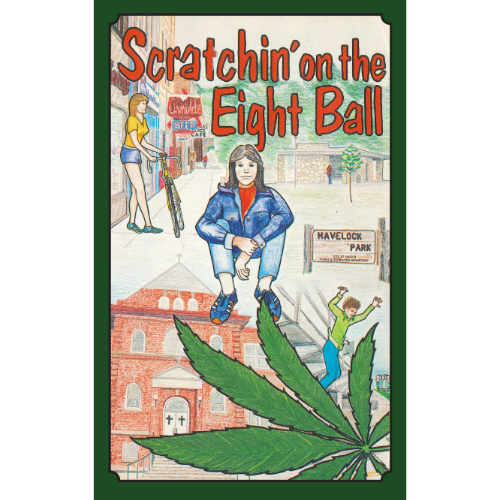
I remember when the manuscript was finally done, and my artist friend called me and said, “Your publisher wants me to include a large marijuana leaf on the front cover of your book. The trouble is, I have no clue what one looks like. Could you do me a favor?”

So, I drove out in the country and picked some ditch weed. I drove all the away across town, sweating it and thinking I was going to get caught for possession! And yet because of that harrowing trip, with weed plants crammed beneath my driver’s seat, the artist, Russ Wahl, ended up with a nice rendition of his marijuana leaf on the front cover of the book.

One other thing happened just before the book went to press, and Russ called me again with a new problem. He said, “You know the young girl we have on the front cover of your book? Well, your publisher gave me an odd request, one that he thinks will sell more books. He wants me to enlarge her breasts!”

“Oh God, no,” I told him. “I know that girl’s mother and she would not want to see her daughter with super large boobs on the front cover of my book. Yes, more kids might be attracted to the book, heck, even the girl might approve, but her mom would strangle me! Just tell him you already sprayed a finishing coat on it and it cannot be changed, and leave her boobs alone!”

The book was released at the Nebraska Librarian’s Convention in Columbus, and after I spoke and sang for 450 librarians, nearly half of the room lined up to get a signed copy of my book. Jerry had brought only 15 copies with him! I lost out on about 200 sales that night. Depressed at this turn of events, I joined four librarians at the end of the evening as they sipped on alcoholic beverages. One teacher summed it up best, slurring her words and saying, “Your firth book and your stoopid publishure brought only fifteen copies? That shertainly shucks!”  I’ve loved librarians ever since.

Media Productions sold 2,000 books the following six months and the sales were all over the place, Texas, New York, California, South Dakota, and the libraries and schools of Nebraska. And then reality set in. I started getting calls from teachers in Lincoln, asking me why my publisher refused to sell them my book. So I called Jerry, and after hearing several excuses as to why he would no longer fulfill orders, he asked me if I wanted to buy back my rights plus the 3,000 books he still had in his warehouse.

He wanted $3400 for the rights and $4.95 for each book. I was stunned. Where was I going to come up with that kind of money? I thought once my book had been published, it would continue to sell and then I would write the next one, and the next. It seemed my first book had hit a dead-end and yet it had been selling so well, and I still had calls from teachers trying to order more. I figured something was very wrong with this whole picture.

So I called a lawyer, Cal Hansen. This was back in 1987, and I remember Cal had to travel to Omaha just to seek advice on copyright issues, as Lincoln was in the dark ages on copyright law back then. Cal came back with some interesting news. “An author’s rights,” he told me, “revert back to the author for FREE, when a publisher is done with the work. Your publisher is evidently using your 3,000 books for a tax write off, so he has no more interest in them. Your rights come back to you free. He would have been ripping you off to charge you even a penny for them, let alone three grand. So I will make a counter offer: Rights for free and 85 cents per book on the 3,000 he still has.”

Sounded good to me. But where was I going to come up with that kind of money?

To be continued . . .